Nervous Fictions by Jess Keiser
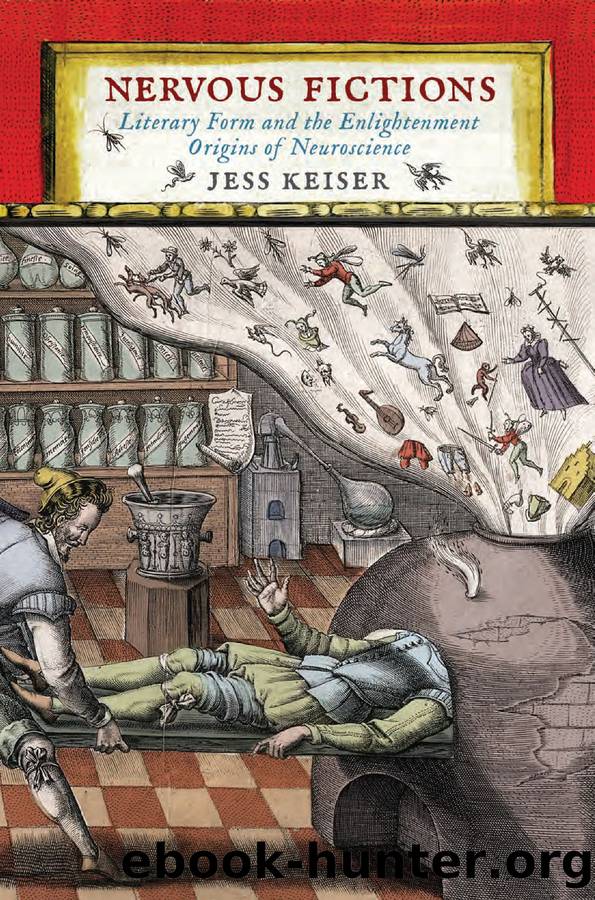
Author:Jess Keiser
Language: eng
Format: epub
ISBN: IDENTIFIER: Keiser
Publisher: University of Virginia Press
Published: 2020-08-04T16:00:00+00:00
The Scalpel of the Scriblerians
I now want to pick up the satiric thread the Spectator papers began to weave by turning to the Memoirs of the Extraordinary Life, Works, and Discoveries of Martinus Scriblerus, a work coauthored, seemingly, by Arbuthnot, Swift, Pope, and Gay. Although not published until 1741, the Memoirs were composed, in bits and pieces, throughout much of the first half of the eighteenth century.21 The chapters on medical matters that interest me here, for example, were probably first written as early as 1714 (roughly two years after Addisonâs mock dissection) but may have undergone revisions as late as 1726 or 1727.22 The Memoirs themselves constitute the biography of the wholly invented, and entirely ridiculous, editor, scholar, and natural philosopher Martin Scriblerus. Ambitious, speculative, and reductive, Martin Scriblerus is the mask Pope, Swift, and their friends wear when they seek to parody some aspect of preeminently âmodernâ modes of thought. He is the successor of the Hack-narrator of Swiftâs Tale of a Tub, now dressed up with a proper name and a suitably absurd life story. He is the official author of texts (actually written by Pope) like Peri Bathous, Or the Art of Sinking in Poetry: an elocution manual designed to aid those hoping to sink, rather than rise, in poetry. He is to be blamed for the long, digressive, always unenlightening footnotes that hang upon the Dunciad, weighing it down with ponderous musings. Most important for my purposes, Martin, as we learn in the Memoirs, is a trained anatomist, one fascinated by the relationship between body and mind. Hence, the central chapters of the Memoirsâa work that, more generally, recounts Martinâs birth, education, first scholarly achievements, and eventual love affairsâconcern Scriblerusâs dissection of the brain, a practice undertaken in the hope of locating the seat of the soul.23
To be sure, as a mock dissection, the Memoirs break certain aspects of the pattern first established by Addisonâs satire. The dream-narrative framing and the attack on a particular character type are absent from this text; the body and brain that Martin cuts into is that of an anonymous malefactor rather than some living embodiment of a particularly pernicious personality trait. But while the Memoirs do not explicitly allude to Addisonâs papers, it nevertheless makes some of the same satirical moves and arrives at a similar conclusion. It, too, is fascinated by the gap between brain matter and the mental qualities somehow arising from it, and it, too, mocks the efforts of the neuroscientist to close that gap through less than purely scientific or empirical means. Like Addisonâs satire, the Memoirs depict dissection as a process that uncovers not real organs but instead figures and fantasies. What we lose in the more scattershot attacks of the Spectator papersâwhich dissect both a Beau and his anatomistsâwe gain in a more thorough focus in the Memoirs on the person of the natural philosopher, since ultimately only Martin, his family, and his âmodernâ methods of knowledge production are the concern of this later text.
Download
This site does not store any files on its server. We only index and link to content provided by other sites. Please contact the content providers to delete copyright contents if any and email us, we'll remove relevant links or contents immediately.
Twisted Games: A Forbidden Royal Bodyguard Romance by Ana Huang(4031)
The Push by Ashley Audrain(2703)
Den of Vipers by K.A Knight(2701)
Win by Harlan Coben(2665)
Echo by Seven Rue(2248)
Baby Bird by Seven Rue(2224)
Beautiful World, Where Are You: A Novel by Sally Rooney(2181)
A Little Life: A Novel by Hanya Yanagihara(2155)
Iron Widow by Xiran Jay Zhao(2127)
Leave the World Behind by Rumaan Alam(2100)
Midnight Mass by Sierra Simone(2017)
Bridgertons 2.5: The Viscount Who Loved Me [Epilogue] by Julia Quinn(1796)
Undercover Threat by Sharon Dunn(1791)
The Four Winds by Hannah Kristin(1775)
Sister Fidelma 07 - The Monk Who Vanished by Peter Tremayne(1670)
The Warrior's Princess Prize by Carol Townend(1632)
Snowflakes by Ruth Ware(1602)
Dark Deception by Rina Kent(1570)
Facing the Mountain by Daniel James Brown(1554)
